

This website uses cookies to improve your experience. We'll assume you're ok with this, but you can opt-out if you wish. Read More

Are you packing, or just unpacked for your study abroad? This post is all about dealing with the unspoken transitions and the fallout. It will help you articulate how you feel and address the instability that comes along with relocation.

Your study abroad is more than just a change in your environment but the catalyst in your becoming. No one ever talks about the 5 (for some simultaneous) transitions that you experience before, during, and even after your time. Whether you’re mid-pack or mid-meltdown, these 5 study abroad transitions framework will help you navigate, verbalise, and comprehend exactly what you’re undergoing.
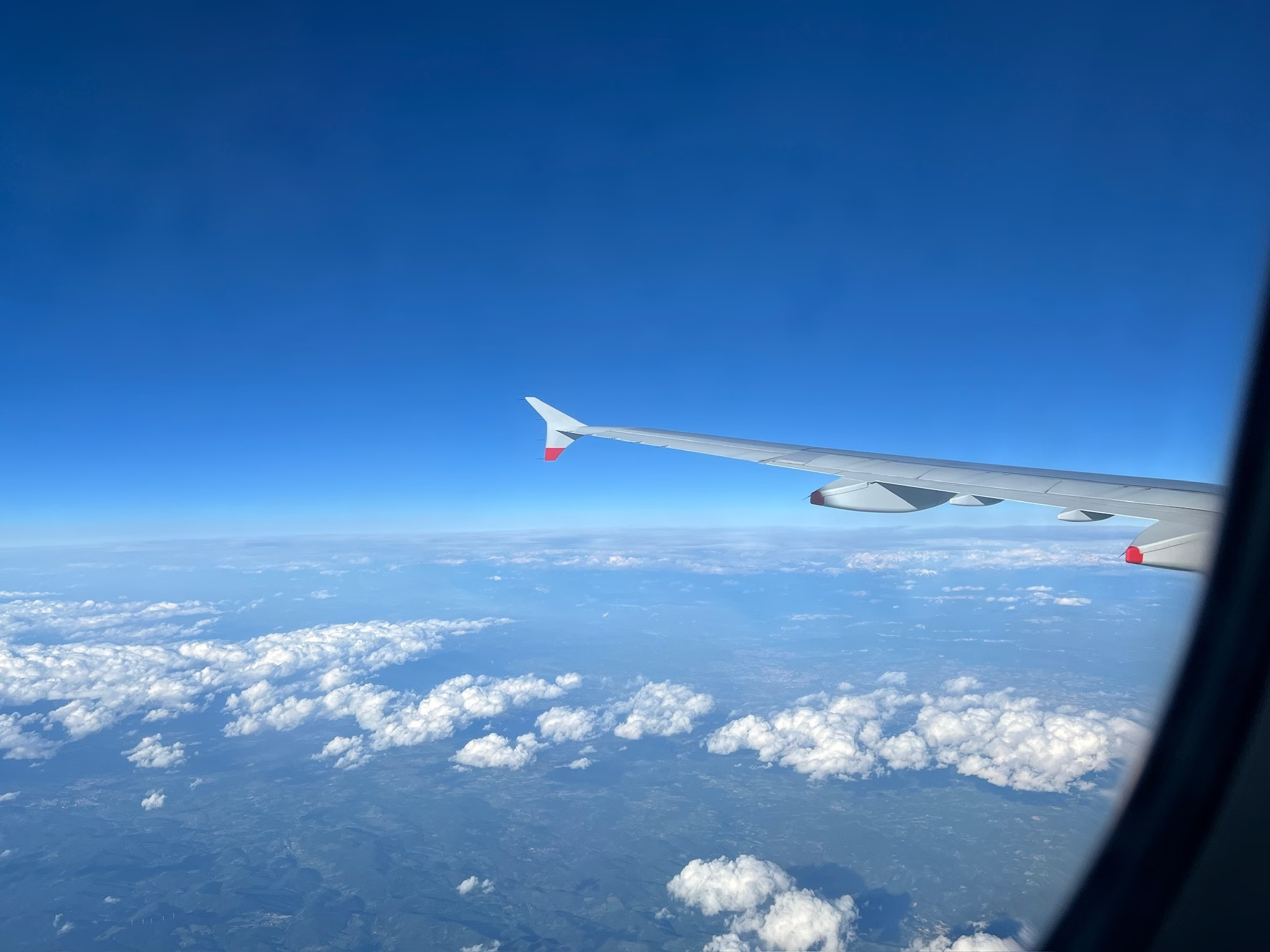

Obviously, this is the most evident transition. But, it doesn’t begin when you get there, it begins before you leave your bedroom. Suddenly, everything that once had its own neat, logical place is now tightly sealed in a vacuum pack or miscellaneously thrown in a random toiletries bag you got a thousand Christmases ago.
See what I mean now about it starting before you leave?
Physical displacement is not an easy thing, not with yourself or your precious belongings. It compounds the further along you are in the moving stage. For some of you, this may be the hardest part… compartmentalising the memories, milestones and mementos that shaped you into a suitcase can cause a lot of pre-traveling stress when you’re already moving abroad.
You’re not alone!
Okay, so you’re feeling stressed, anxious, displaced… but now what? How can you deal with locational transition pre or during your study abroad?
You can:
Accept how you feel; you’re allowed to mourn what you’re trading while still remaining grateful and excited.
Dr Diane Sanford (clinical psychologist) suggests that you focus on these 4 pillars: nutrition, exercise, sleep, and stress reduction. She states that the better you feel physically, the more emotional and mental energy you will have.
As we touched on earlier, you may experience mental or emotional fatigue; this is the one that catches you off guard. I didn’t realise that I was tired or was experiencing any kind of disruption until I had actually moved!
My mum had just left after helping me unpack and I decided to go for a walk around the area to explore. I found a cute quirky bookshop and decided to buy some books with cash…only to realise that I had left my books on the counter after I paid and walked away! The owner of the bookstore frantically ran to hand me the abandoned books I had just paid for.
Now, I had never done that before. Ever. So that told me something I wasn’t consciously aware of: I was mentally fatigued from the transition. Even though I thought I was totally fine, and actually excited to be alone and explore, I clearly wasn’t at my best. This made me realise that I may have neglected myself in some capacity having done something so careless. I was clearly dealing with some subconscious feeling of being uprooted from my daily life. And it wasn’t the only time I had done it!
Processing new social cues, a new language in a new environment can make your brain run at full capacity without you even realising. It’s okay to experience cognitive overload.
Well, cognitive behavioural therapist Saboohi Gill recommends to:
Most importantly: Be patient with yourself, rest counts as productivity too.
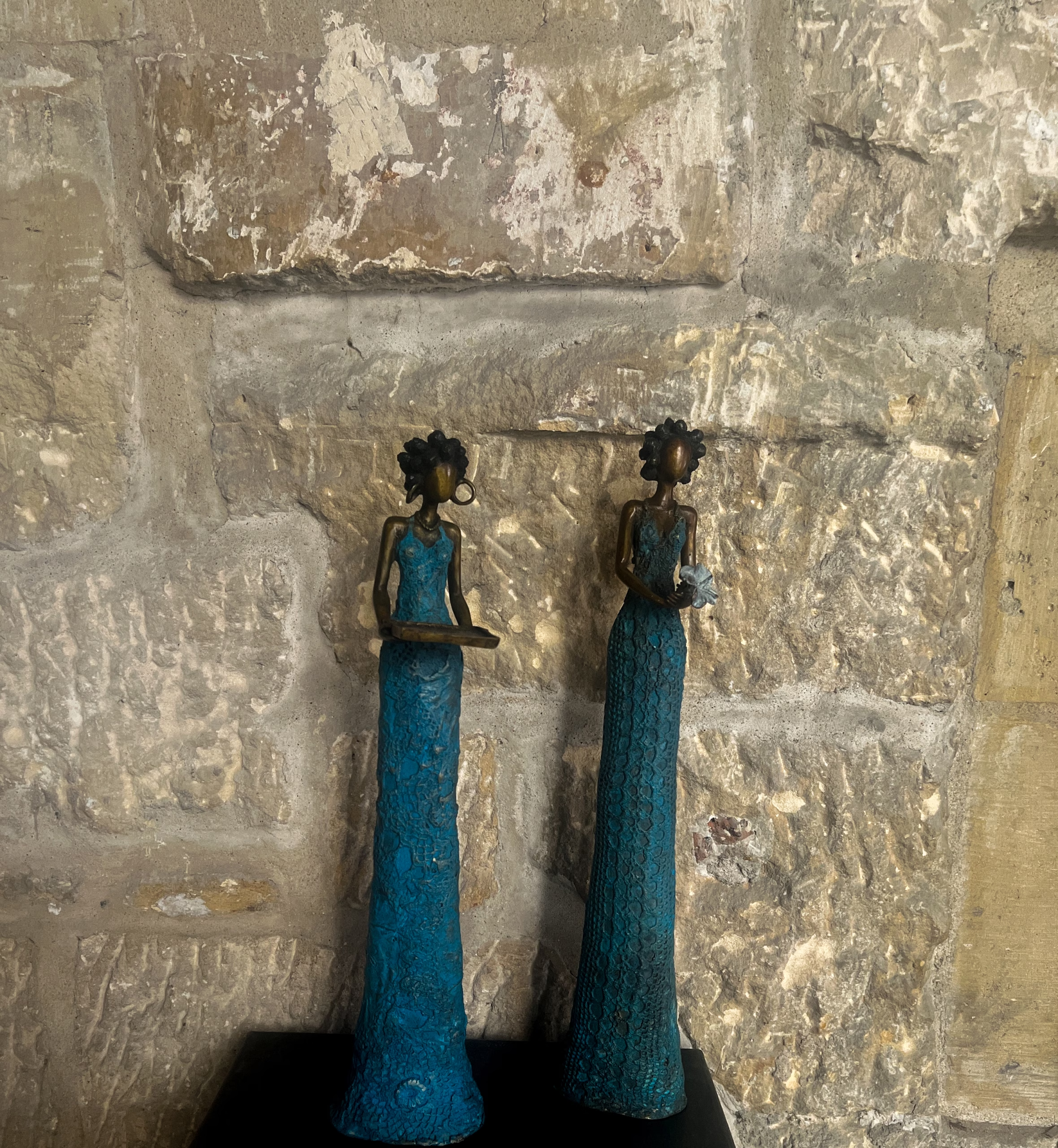

Proximity often defines closeness in relationships, so how do you navigate this when you’re moving away from your loved ones who you keep so close?
This is an opportunity for you to refine your relationship management skills; be more intentional about who you maintain a relationship with; and be grateful for those who are in your close circle in a different way.
Personally, as someone who doesn’t post on social media often, I decided to post intentionally on my close friends so they could still see my face and hear my voice! It sounds obvious, but when your schedules don’t align, this is the best way for them to see you’re still okay without having to reach out individually.
It can get hard, and it can definitely get lonely, however, a long distance relationship with your inner circle is its own skill, but a necessary life experience.
Studying abroad catalyses self-discovery outside of your typical environment. You get to find who you truly are without external influences from your nearest-and-dearests. This is an important transition for you. Yes, while bittersweet, it’s a cannon event.
This is an opportunity to see how your relationships evolve, not just with your loved ones, or with the new connections you will form, but also with yourself. Your interaction with self manifests beautifully when you embrace the change. Of course, there are those who haven’t had that experience, and that’s totally fine. The most important thing is to expect a good experience rather than to anticipate a bad one.
For starters, you can:
For some of you, your year abroad may be the final year of university. For others, it’s just an experience year. One thing that is consistent is that it’s a great opportunity for you to explore who you are outside of your close knit community.
Identity transitions are hard because you may not even realise you’re in one. Your appetites start changing, you struggle to identify with what used to be your marker of distinction, you’re distant from what used to be closely associated with you.
Get closer to God – the more time I spent with God the more confident I became. I anchored myself to my faith. A book that helped me do this during one of my most recent transitions was ‘From Here to There’ by Isi Igenegba.
I had just graduated and was looking for a job, but in that period I didn’t know what I wanted. I knew I was qualified but didn’t feel qualified (mainly because of my poor interview skills). Reading this book helped me understand where to place myself – nowhere. When you’re transitioning you feel displaced because God is moving you for better things and that means no longer identifying with who you once were.
You may not be theistic, but the principle remains the same: unnecessary energy focusing on negative outcomes rather than meditating on positive outcomes drastically changes your life experience.
As mentioned earlier, gratitude changes your brain chemistry, which ultimately changes your behaviour. Listening to praise gospel songs definitely helped me rewire my typical thought patterns.
Now, no one ever said this was easy. Gratitude requires intentionality, and focusing on your abundance rather than your lack…easier said than done, right?
But if music activates the hippocampus and amygdala to provoke an emotional response within us (Allison Eck, Harvard Medicine ), then why don’t we concentrate on songs and lyrics that encourage gratitude?
It’s an inevitable yet indescribable stage that everyone goes through yet experiences differ massively. Life-stage transitions are indicators of a bigger, underlying, for a lack of better words, ‘conundrum’: aging. People react to this differently, my best advice? Be grateful, because the alternative is morbid. Fear and anxiety is not a logical response to getting older, because that’s the point of life.
With age comes experience, and with experience comes change. This is the life-stage transition. You cannot avoid it, otherwise, you will remain small, stuck, and stunted.
A study abroad rarely happens in isolation. It usually coincides with a bigger life shift: finishing university, entering your twenties, figuring out what you actually want from your career and your life.
Your year abroad is a unique lifestage that not many people get to experience because – let’s face it- you need to be bold to leave everything behind (again). You may not agree, you may not feel bold, but it’s bold. You’re expressing complete trust (whether you realise it or not) in your ability to survive without your organic crutches (mum, dad, best friend, cat, dog, 2012 Justin Bieber poster, whatever).
Importantly, a study abroad distinguishes your transition into adulthood. It’s developmental. You’re declaring your entrance into official independence and self-discovery. And guess what? It was voluntary. That’s bold.
It’s a chance to make new friends. Many people will be going through the same thing as you or would have gone through the same thing. This is an open door to expanding your network surrounding yourself around like-minded people, or those who want to guide you who were once in your position. The more community you have the easier it is to pass through a phase of life.
The most obvious life-stage transition for me was the shift from being a student to employment. My study abroad wasn’t as difficult because my identity was still ‘student’. Whereas I struggled with lack of structure in my day while I was job searching. It put into perspective what I truly prioritise when I have free time. As a result, I became more self-reflective which culminated in being more intentional.
Even though this transition doesn’t happen in isolation you may feel isolated; be kind to yourself. You can do this by lowering your expectations on being able to smoothly transition.
Embrace the changes and uncertainty, it’s a sign that something significant is happening… you’re becoming. Try journaling and affirmations. According to a study on positive self-talk, ‘journaling techniques allow for deep self-reflection’ which ‘improv[es]’ your ‘ability to manage emotions’. Read the study here:
Being unsettled doesn’t mean you made the wrong choice, even when you’re convinced you’re falling apart.
Here’s the next step: Name what you’re feeling, which transition is hitting hardest right now? Knowing it has a name makes it feel less like chaos and more like a phase, which it is.
Talk about it, to friends; to family; to other people on their study abroad who are probably feeling exactly the same way.
This 5 Study Abroad Transition Framework has, hopefully, demonstrated that you don’t solve transitions, you move through them.
There are five key transitions: locational, mental, relational, identity, and life-stage. Most people experience all of them simultaneously rather than one at a time.
Yes. Cognitive overload, forgetfulness, and low mood are common responses to the significant environmental and social changes of living abroad. Your brain is working harder than usual.
Culture shock typically peaks in the first one to three months and eases as routines and relationships are established, though it can resurface at different points throughout the year.
Scheduled calls, realistic expectations, and accepting that relationships will evolve rather than stay static are the most effective strategies for maintaining connections from home.
For many people, yes. Removing yourself from your usual social context often accelerates self-discovery and personal growth, sometimes revealing parts of your identity that had never had space to emerge before. Arguably, your identity doesn’t ‘change’, but evolve and reveal who you truly are.
If you want to read more on dealing with transitions and relocation, here are a few good reads below:
How Music Resonates in the Brain | Harvard Medicine Magazine
How Incoming College Students Can Manage Their Identity In The College Transition
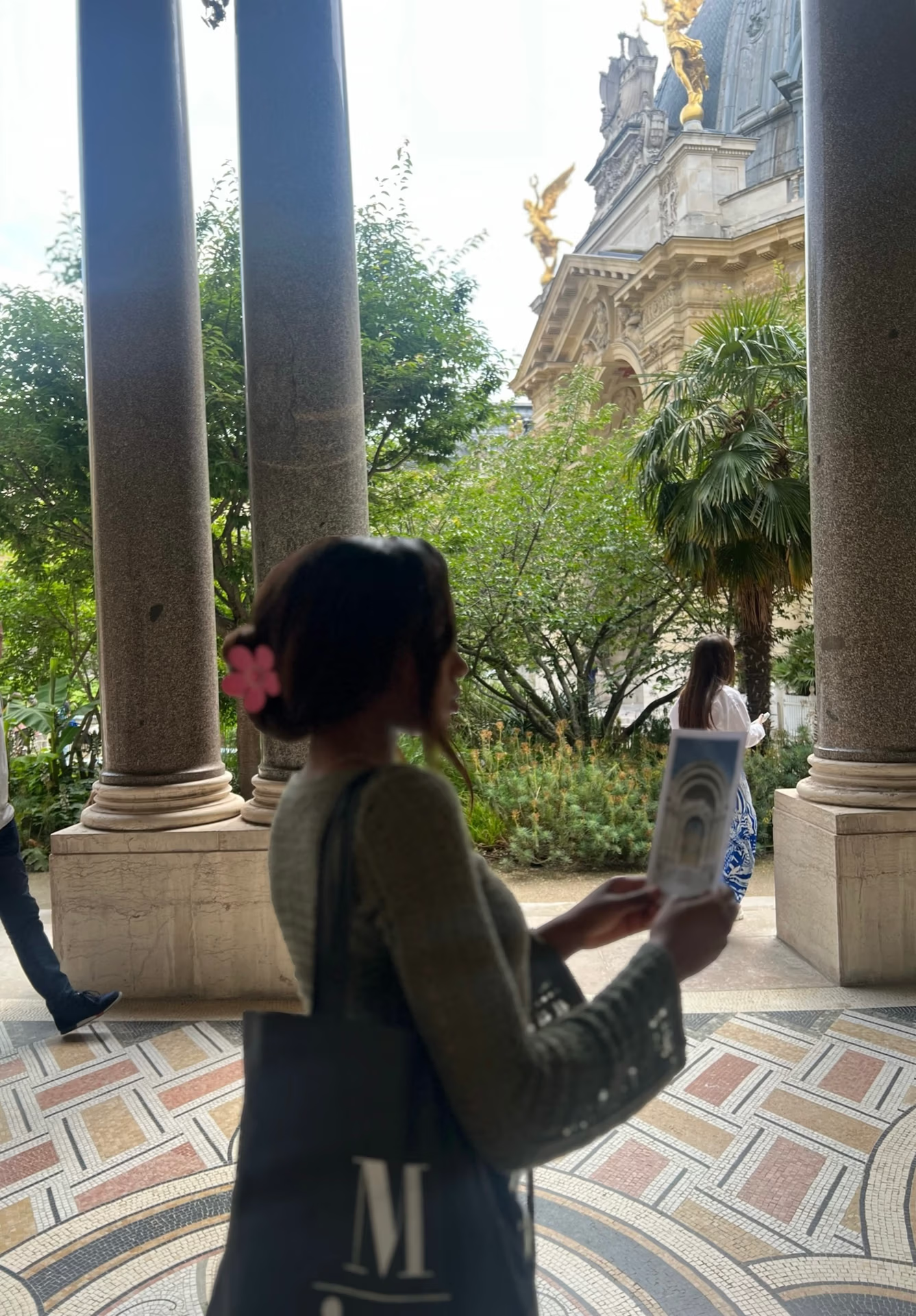
A passionate and creative female blogger who is navigating living in the city in her 20s
This website uses cookies to improve your experience. We'll assume you're ok with this, but you can opt-out if you wish. Read More
Cookie Settings